publications
publications by categories in reversed chronological order. generated by jekyll-scholar.
2026
-
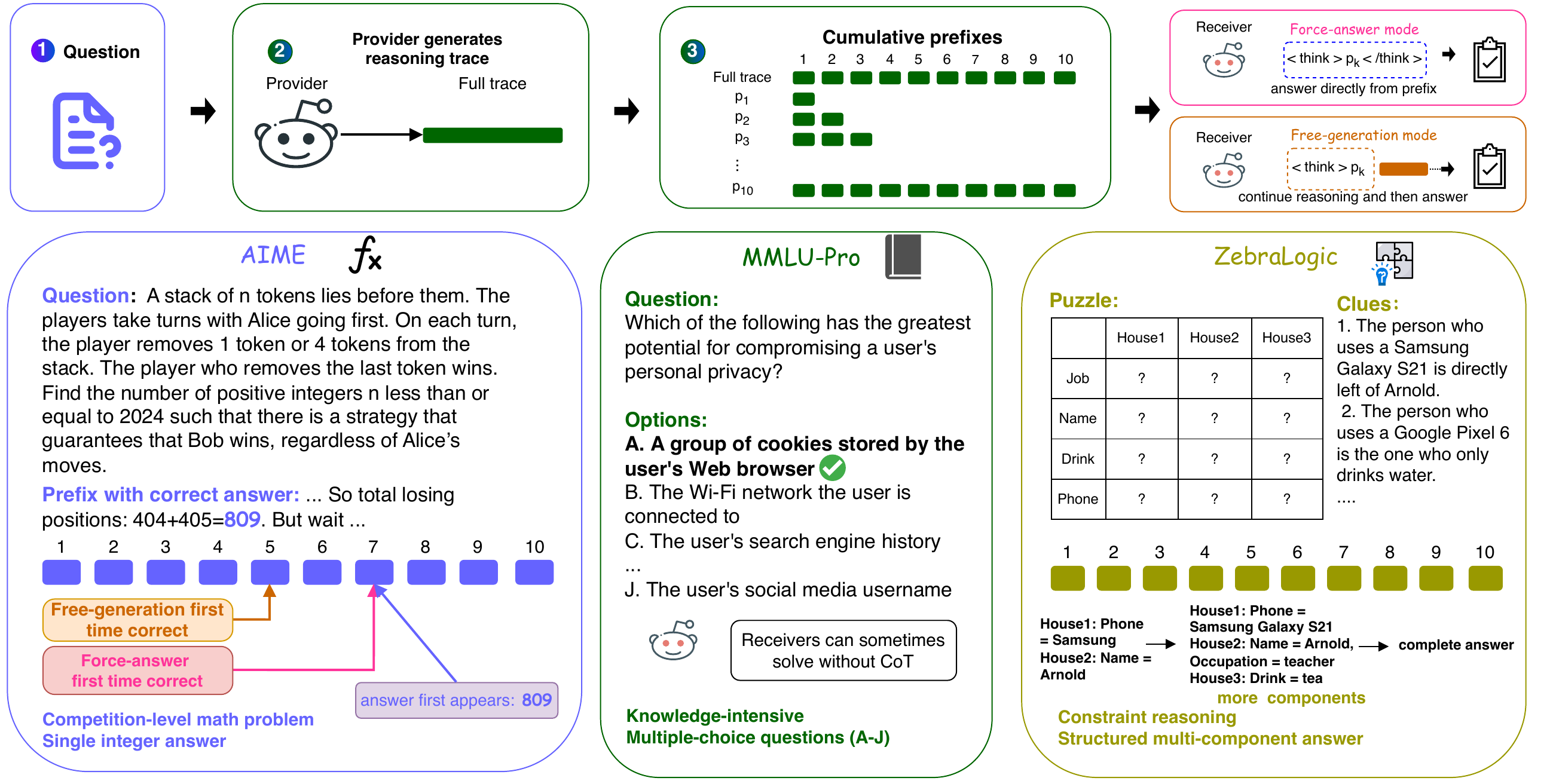 Reasoning That Travels: Dissecting How Chain-of-Thought Transfers Across ModelsXinyuan Cheng*, B. Chen*, P. Mondorf, and 1 more authorarXiv preprint arXiv:2605.28913, 2026
Large reasoning models (LRMs) often generate extensive chain-of-thought (CoT) traces before producing a final answer. As explicit textual artifacts, these traces can be passed to other models to solve the same task, enabling cross-model reasoning transfer. Yet successful transfer alone does not reveal how the provided CoT contributes to another model’s answer. We study this question with a controlled provider–receiver framework, where a provider generates a reasoning trace and a receiver solves the same problem from increasingly longer trace prefixes. We compare force-answer, where the receiver answers directly from the prefix, with free-generation, where it may continue reasoning before answering. Across models and benchmarks, full traces often transfer successfully, but prefix trajectories reveal distinct mechanisms. In force-answer mode, AIME transfer is largely driven by explicit answer availability. MMLU-Pro instead reflects a larger role for receiver competence, while ZebraLogic depends on partial structured-answer information rather than complete-answer leakage alone. In free-generation mode, partial CoTs improve performance across benchmarks, indicating that prefixes can guide continued reasoning. Finally, answer agreement among receivers provides a gold-free signal for stopping provider reasoning early. Overall, cross-model CoT transfer is not a single phenomenon: it can reflect answer extraction, reasoning scaffolding, or receiver-dependent competence.
@article{cheng2026reasoning, title = {Reasoning That Travels: Dissecting How Chain-of-Thought Transfers Across Models}, author = {Cheng, Xinyuan and Chen, B. and Mondorf, P. and Plank, B.}, journal = {arXiv preprint arXiv:2605.28913}, year = {2026}, url = {https://arxiv.org/abs/2605.28913}, } - XToM: Exploring the Multilingual Theory of Mind for Large Language ModelsChunkit Chan, Yauwai Yim, Hongchuan Zeng, and 14 more authorsIn Proceedings of the 64th Annual Meeting of the Association for Computational Linguistics (Volume 1: Long Papers), Jul 2026
Theory of Mind (ToM)—the ability to infer mental states in others—is pivotal for human social cognition. Existing evaluations of ToM in LLMs are largely limited to English, neglecting the linguistic diversity that shapes human cognition. This limitation raises a critical question: can LLMs exhibit Multilingual Theory of Mind—the capacity to reason about mental states across diverse linguistic contexts? To address this gap, we present XToM, a rigorously validated multilingual benchmark that evaluates ToM across five languages and incorporates diverse, contextually rich task scenarios. Using XToM, we systematically evaluate LLMs (e.g., DeepSeek R1), revealing a pronounced dissonance: while models excel in multilingual language understanding, their ToM performance varies across languages. Our findings expose limitations in LLMs’ ability to replicate human-like mentalizing across linguistic contexts.
@inproceedings{chan-etal-2026-xtom, title = {{XT}o{M}: Exploring the Multilingual Theory of Mind for Large Language Models}, author = {Chan, Chunkit and Yim, Yauwai and Zeng, Hongchuan and Zou, Zhiying and Cheng, Xinyuan and Sun, Zhifan and Deng, Zheye and Chung, Kawai and Ao, Yuzhuo and Yixiang, Fan and Jiayang, Cheng and Nie, Ercong and Wong, Ginny and Schmid, Helmut and Schuetze, Hinrich and See, Simon and Song, Yangqiu}, editor = {Liakata, Maria and Moreira, Viviane P. and Zhang, Jiajun and Jurgens, David}, booktitle = {Proceedings of the 64th Annual Meeting of the {A}ssociation for {C}omputational {L}inguistics (Volume 1: Long Papers)}, month = jul, year = {2026}, address = {San Diego, California, United States}, publisher = {Association for Computational Linguistics}, url = {https://aclanthology.org/2026.acl-long.805/}, pages = {17681--17716}, isbn = {979-8-89176-390-6} } - Gmg: A video prediction method based on global focus and motion guidedY. Du, H. Liu, H. Peng, and 3 more authorsIEEE Transactions on Circuits and Systems for Video Technology, 2026
Recent years, weather forecasting has gained significant attention. However, accurately predicting weather remains a challenge due to the rapid variability of meteorological data and potential teleconnections. Current spatiotemporal forecasting models primarily rely on convolution operations or sliding windows for feature extraction. These methods are limited by the size of the convolutional kernel or sliding window, making it difficult to capture and identify potential teleconnection features in meteorological data. Additionally, weather data often involve non-rigid bodies, whose motion processes are accompanied by unpredictable deformations, further complicating the forecasting task. In this paper, we propose the GMG model to address these two core challenges. The Global Focus Module, a key component of our model, enhances the global receptive field, while the Motion Guided Module adapts to the growth or dissipation processes of non-rigid bodies. Through extensive evaluations, our method demonstrates competitive performance across various complex tasks, providing a novel approach to improving the predictive accuracy of complex spatiotemporal data.
@article{du2026gmg,
  title = {Gmg: A video prediction method based on global focus and motion guided},
  author = {Du, Y. and Liu, H. and Peng, H. and Cheng, Xinyuan and Wu, C. and Zhang, J.},
  journal = {IEEE Transactions on Circuits and Systems for Video Technology},
  volume = {36},
  number = {6},
  pages = {8048--8063},
  year = {2026},
  doi = {10.1109/TCSVT.2026.3657055},
  url = {https://doi.org/10.1109/TCSVT.2026.3657055}
}
2025
- Predicting sudden stratospheric warmings using video prediction methodsY. Du, J. Zhang, Xinyuan Cheng, and 3 more authorsGeophysical Research Letters, 2025
Sudden Stratospheric Warmings (SSWs) are weather phenomena occurring in polar regions, and have a profound impact on mid-latitude cold waves. In this paper, within a deep learning framework, we introduce video prediction techniques into SSW events forecasting for the first time. We develop a Global Attention Motion Decoupled Recurrent Neural Network (GMRNN) to better capture the detailed changes of the polar vortex. Through experiments on representative SSW events in 2018, 2019, and 2021, our model can stably predict SSW events 20 days in advance and accurately capture the morphological changes of the stratospheric polar vortex. Furthermore, we compared our model with baseline models, including PredRNN, MotionRNN, and the sub-seasonal to seasonal (S2S) integrated forecast models from ECMWF, CMA, and ECCC. The results indicate that our model outperforms these models across various evaluation metrics, compare with ensemble prediction results GMRNN’s Structural Similarity increased by approximately 11.2%, and the Anomaly Correlation Coefficient increased by approximately 9.5%. The GMRNN model exhibits superior stability and possesses prediction potential over a longer period.
@article{du2025ssw,
  title = {Predicting sudden stratospheric warmings using video prediction methods},
  author = {Du, Y. and Zhang, J. and Cheng, Xinyuan and Lu, Y. and Li, D. and Tian, W.},
  journal = {Geophysical Research Letters},
  volume = {52},
  number = {8},
  pages = {e2024GL113993},
  year = {2025},
  doi = {10.1029/2024GL113993},
  url = {https://doi.org/10.1029/2024GL113993}
}
2024
- Do large language models understand conversational implicature - a case study with a Chinese sitcomS. Yue, S. Song, Xinyuan Cheng, and 1 more authorIn Proceedings of the 23rd Chinese National Conference on Computational Linguistics (Volume 1: Main Conference), 2024
Understanding the non-literal meaning of an utterance is critical for large language models (LLMs) to become human-like social communicators. In this work, we introduce SwordsmanImp, the first Chinese multi-turn-dialogue-based dataset aimed at conversational implicature, sourced from dialogues in the Chinese sitcom My Own Swordsman. It includes 200 carefully handcrafted questions, all annotated on which Gricean maxims have been violated. We test eight closed-source and open-source LLMs under two tasks: a multiple-choice question task and an implicature explanation task. Our results show that GPT-4 attains human-level accuracy (94%) on multiple-choice questions. CausalLM demonstrates a 78.5% accuracy following GPT-4. Other models, including GPT-3.5 and several open-source models, demonstrate a lower accuracy ranging from 20% to 60% on multiple-choice questions. Human raters were asked to rate the explanation of the implicatures generated by LLMs on their reasonability, logic and fluency. While all models generate largely fluent and self-consistent text, their explanations score low on reasonability except for GPT-4, suggesting that most LLMs cannot produce satisfactory explanations of the implicatures in the conversation. Moreover, we find LLMs’ performance does not vary significantly by Gricean maxims, suggesting that LLMs do not seem to process implicatures derived from different maxims differently. Our data and code are available at https://github.com/sjtu-compling/llm-pragmatics.
@inproceedings{yue2024implicature,
  title = {Do large language models understand conversational implicature - a case study with a Chinese sitcom},
  author = {Yue, S. and Song, S. and Cheng, Xinyuan and Hu, H.},
  booktitle = {Proceedings of the 23rd Chinese National Conference on Computational Linguistics (Volume 1: Main Conference)},
  address = {Taiyuan, China},
  publisher = {Chinese Information Processing Society of China},
  year = {2024},
  pages = {1270--1285},
  url = {https://aclanthology.org/2024.ccl-1.98/},
}
2023
- Argugpt: Evaluating, understanding and identifying argumentative essays generated by GPT modelsY. Liu, Z. Zhang, W. Zhang, and 5 more authorsarXiv preprint arXiv:2304.07666, 2023
AI generated content (AIGC) presents considerable challenge to educators around the world. Instructors need to be able to detect such text generated by large language models, either with the naked eye or with the help of some tools. There is also growing need to understand the lexical, syntactic and stylistic features of AIGC. To address these challenges in English language teaching, we first present ArguGPT, a balanced corpus of 4,038 argumentative essays generated by 7 GPT models in response to essay prompts from three sources: (1) in-class or homework exercises, (2) TOEFL and (3) GRE writing tasks. Machine-generated texts are paired with roughly equal number of human-written essays with three score levels matched in essay prompts. We then hire English instructors to distinguish machine essays from human ones. Results show that when first exposed to machine-generated essays, the instructors only have an accuracy of 61% in detecting them. But the number rises to 67% after one round of minimal self-training. Next, we perform linguistic analyses of these essays, which show that machines produce sentences with more complex syntactic structures while human essays tend to be lexically more complex. Finally, we test existing AIGC detectors and build our own detectors using SVMs and RoBERTa. Results suggest that a RoBERTa fine-tuned with the training set of ArguGPT achieves above 90% accuracy in both essay- and sentence-level classification. To the best of our knowledge, this is the first comprehensive analysis of argumentative essays produced by generative large language models. Machine-authored essays in ArguGPT and our models will be made publicly available at https://github.com/huhailinguist/ArguGPT.
@article{liu2023argugpt,
  title = {Argugpt: Evaluating, understanding and identifying argumentative essays generated by GPT models},
  author = {Liu, Y. and Zhang, Z. and Zhang, W. and Yue, S. and Zhao, X. and Cheng, Xinyuan and Zhang, Y. and Hu, H.},
  journal = {arXiv preprint arXiv:2304.07666},
  year = {2023},
  url = {https://arxiv.org/abs/2304.07666}
}