I am a Master’s student in Computational Linguistics and Informatics at the Center for Information and Language Processing (CIS) at Ludwig-Maximilians-Universität München (LMU Munich). My work focuses on evaluating and interpreting foundation model behavior beyond single accuracy numbers.
My research interests include large language models, reasoning, retrieval-augmented generation (RAG), multilingual and pragmatic evaluation, and human label variation (HLV).
Before that, I received my Bachelor’s degree from Shanghai Jiao Tong University (SJTU).
Currently, I am also a Scientific Programmer at Munich AI & NLP (MaiNLP), where I am developing an open-source, research-oriented toolkit for HLV.
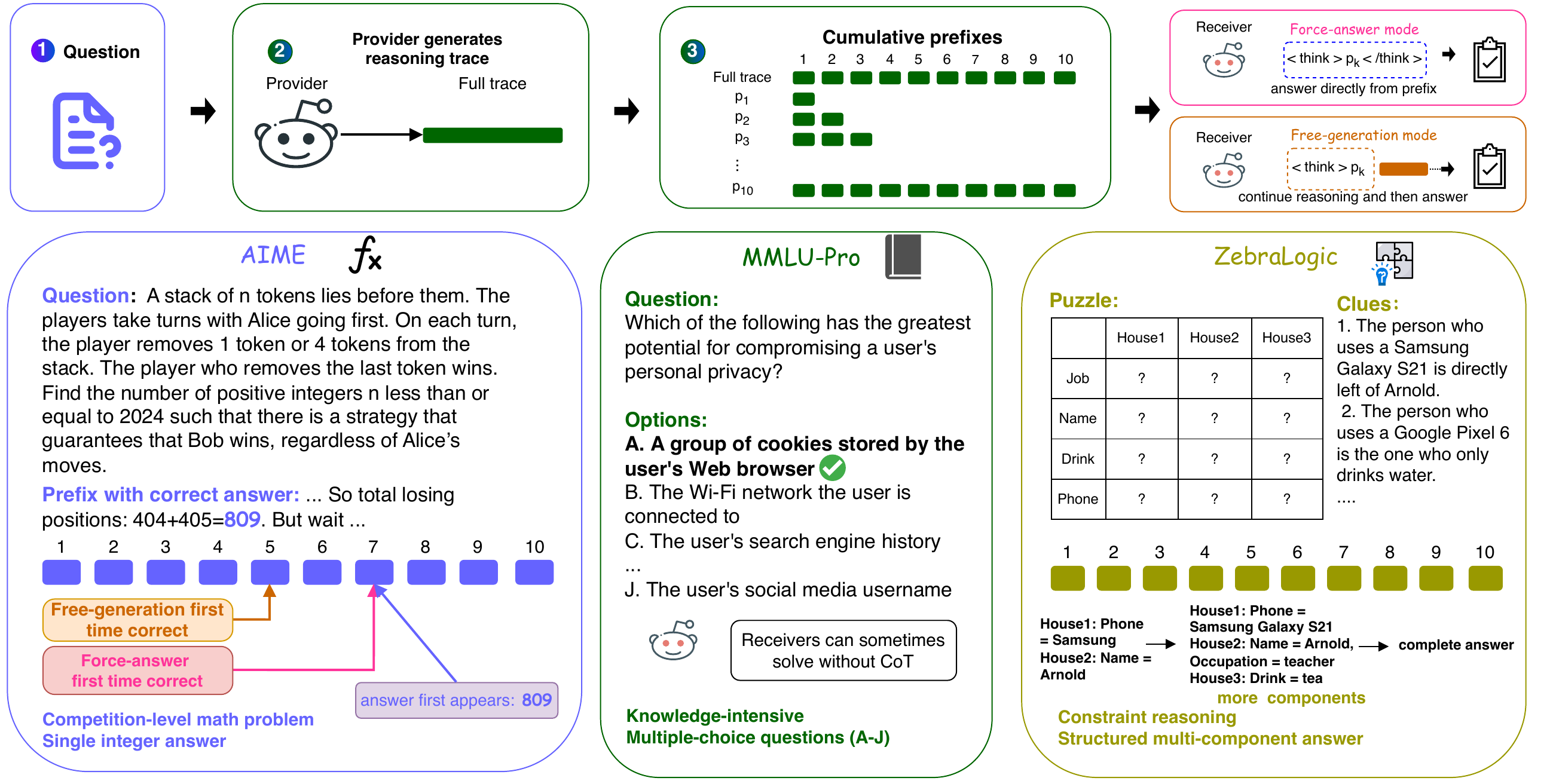
Large reasoning models (LRMs) often generate extensive chain-of-thought (CoT) traces before producing a final answer. As explicit textual artifacts, these traces can be passed to other models to solve the same task, enabling cross-model reasoning transfer. Yet successful transfer alone does not reveal how the provided CoT contributes to another model’s answer. We study this question with a controlled provider–receiver framework, where a provider generates a reasoning trace and a receiver solves the same problem from increasingly longer trace prefixes. We compare force-answer, where the receiver answers directly from the prefix, with free-generation, where it may continue reasoning before answering. Across models and benchmarks, full traces often transfer successfully, but prefix trajectories reveal distinct mechanisms. In force-answer mode, AIME transfer is largely driven by explicit answer availability. MMLU-Pro instead reflects a larger role for receiver competence, while ZebraLogic depends on partial structured-answer information rather than complete-answer leakage alone. In free-generation mode, partial CoTs improve performance across benchmarks, indicating that prefixes can guide continued reasoning. Finally, answer agreement among receivers provides a gold-free signal for stopping provider reasoning early. Overall, cross-model CoT transfer is not a single phenomenon: it can reflect answer extraction, reasoning scaffolding, or receiver-dependent competence.
@article{cheng2026reasoning,title={Reasoning That Travels: Dissecting How Chain-of-Thought Transfers Across Models},author={Cheng, Xinyuan and Chen, B. and Mondorf, P. and Plank, B.},journal={arXiv preprint arXiv:2605.28913},year={2026},url={https://arxiv.org/abs/2605.28913},}